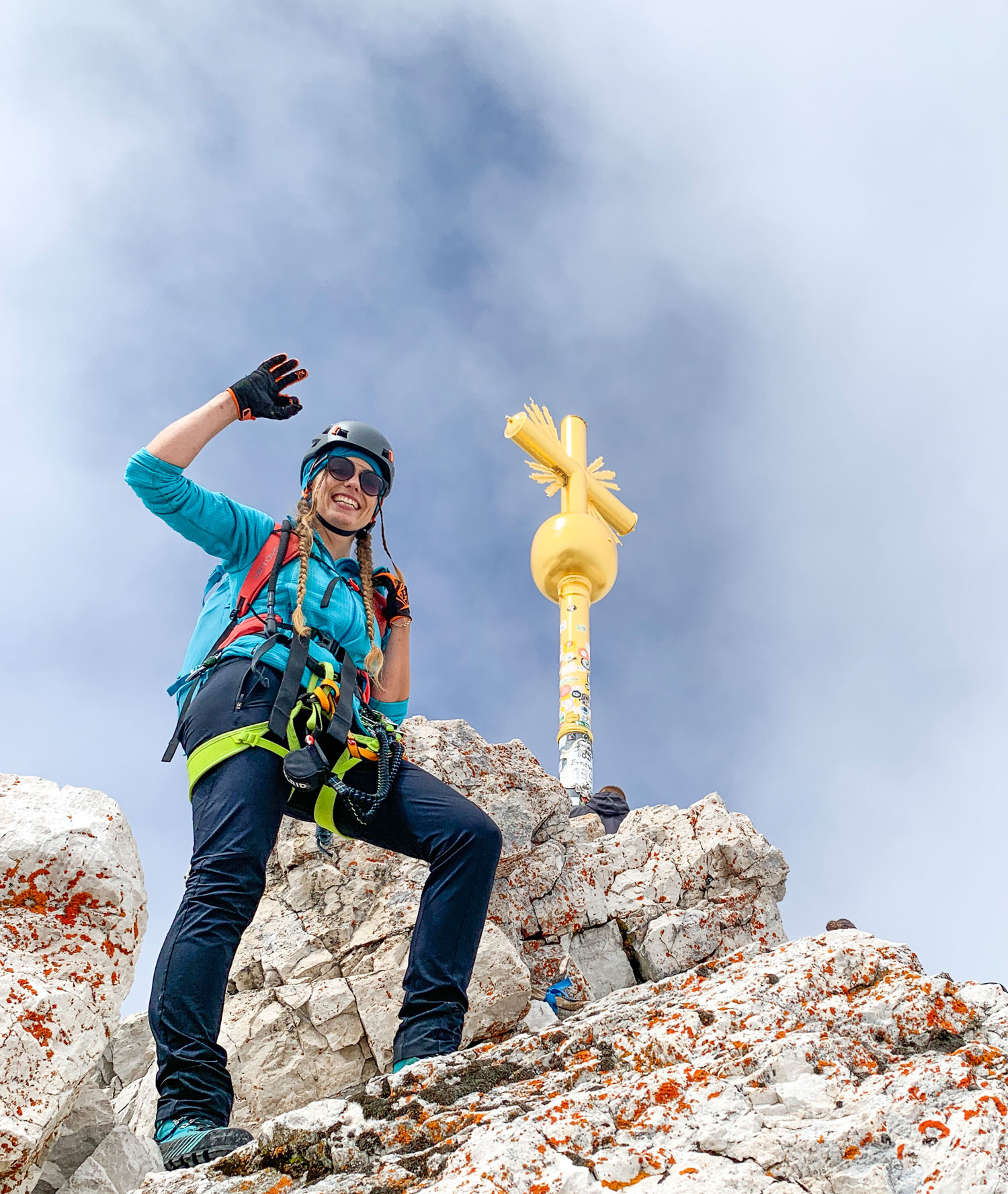
The Zugspitze is Germany's highest mountain. This giant near Garmisch-Partenkirchen rises 2.962 metres into the sky. No wonder it's also one of the country's most popular destinations. Surely every local wants to stand on the roof of Germany at least once in their life. This time, I didn't take the cable car to the top: I hiked up.
Date set. Let's go!
On foot, the route from Hammersbach through the Höllental to the summit involves just under 2.400 metres of elevation gain. We want to make the tour a little less demanding, especially since filming for YouTube always takes up a bit of extra time. So we plan a night at the Höllentalangerhütte, set a date and reserve two beds.
When the weather calls for flexibility
Two days beforehand: rain in Munich. What will the weather be like on our planned date? Bad. With plenty of thunderstorms. Tomorrow, though, might still be quite good. We change our plans, rearrange other commitments and spontaneously drive to Garmisch-Partenkirchen that afternoon, a day earlier than planned.
The rain is slowly easing off, and every now and then the sun even manages to break through the clouds as we park the car in Hammersbach. The 24-hour parking ticket costs 12 euros. Pretty expensive, but at least we can pay by card.
Uphill through the Höllentalklamm
I usually find the first part of a hike rather boring. Often it's just an uphill walk through a forest. This time is different. Our first stretch uphill takes us through the Höllentalklamm.
Water roars all around me, thundering past at full volume. In places it forms waterfalls, putting the full force of the river on display. But the waterfalls aren't just in the riverbed; they're also on the rock walls surrounding us.
Again and again, we leap through torrents of water that suddenly come crashing down on us from above. Before long, my clothes are soaked through. I really should have put on my rain jacket. It's seriously wet in here. Luckily, it isn't much longer before we reach the Höllentalangerhütte.


The early bird avoids the traffic jam
We start early the next morning. The alarm goes off at 4:30. Everyone knows those pictures of crowds stuck in a traffic jam on the via ferrata to the Zugspitze. We'd like to avoid that scenario. In the early morning twilight, we climb from the hut to the start of the Höllentalsteig.
I glance back. Behind me, the blood-red sun is just creeping over the first ridges. Slowly, the landscape is bathed in warm light. Perfect. In the glow of the rising sun, we tackle the first features of the via ferrata, the "Leiter" and the "Brett". Everything here is very well secured. Even so, my fear of heights makes me grateful for my via ferrata kit on more than one occasion. It always gives me a little extra sense of security, even if it's only in my head.
The goal in sight
A little later, we see our goal for the first time. By now, the route no longer follows a steel cable but continues uphill through scree. And way back there, the Zugspitze's golden summit cross is already glinting in the sun. But it's closer than it looks—or rather, it only looks close. There's still just under 1.000 metres of elevation to climb.
Step by step, I trudge on towards the Höllentalferner. Depending on the conditions, crampons are essential here, sometimes even full glacier gear. We decide not to use crampons. There's still a little snow on the ice, and the many climbers have trampled it into convenient steps.
| Facts & figures for the hike from Piz Scalottas to Piz Danis | |
| Duration | approx. 8 h |
| Elevation gain | ↑2.200 m |
| Distance | 10 km |
| Difficulty | Difficult |
Tackling the bergschrund
Then I find myself facing what is probably the most difficult part of the tour: the so-called bergschrund. Over the course of the summer, the glacier pulls further and further away from the rock face, leaving a gap between the ice and the rock. That's what we have to cross, because the route to the summit continues up the rock face.
At the end of July this year, the challenge is still quite manageable. One big step and, just like that, I'm across. A fixed rope provides extra support. But the difficult section isn't over yet. For about five metres, the route goes straight up without any staples or footholds.
The soles of my mountain boots are still damp, making them a little slippery on the rock. I carefully put one foot in front of the other, clip my via ferrata kit onto the steel cable and am relieved when the route levels out again, with plenty of room to stand.
Via ferrata all the way to the end
The hardest part may be behind me, but the via ferrata has only just begun. Metre by metre, we keep climbing, always following the steel cable, with a sheer drop below and wonderful views all around.
The cable car is already clearly audible in the background. It sounds so close. I look up. It's still a long way off. Phew. I'm starting to feel the effort. Even with our overnight stay at the hut, we're still climbing just under 1.800 metres of elevation today. And around 300 metres are still ahead of us.


A high five for the summit
Then, finally, the summit cross is right in front of me. I stroke the cross, celebrate the climb with a high five and revel in being at the top. Here, at the highest point in the Federal Republic. On the roof of Germany. On the 2.962-metre-high Zugspitze!
The endorphins kick in. The effort is forgotten in an instant. Oh, I love this feeling at the summit. That feeling of having made it. It will probably carry me through the whole week again …